
Herniated Disc: Symptoms, Causes and Treatment
Herniated Disc: A Serious Condition, But Not Without Solutions
A herniated disc is one of the most common and disabling causes of back pain and sciatica.
Those who suffer from it often already have a diagnosis, have tried various treatments, and continue to live with chronic pain that limits their quality of life and freedom of movement.
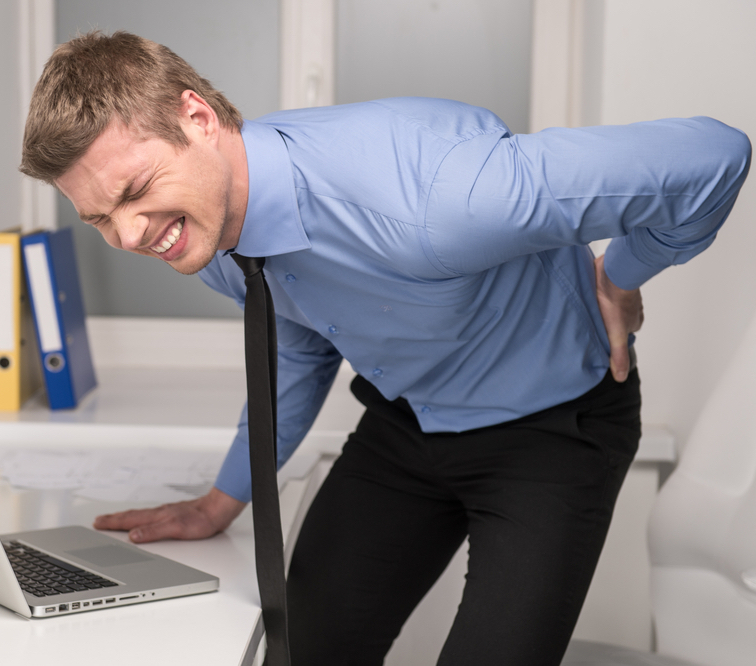
If you’re reading this page, you’re likely experiencing just that: pain radiating down your leg or arm, difficulty sitting, sleeping, or walking, possibly accompanied by tingling or muscle weakness.
When pain persists despite medications, physical therapy, or injections, it’s understandable to feel discouraged.
At Milano Chiropratica – Studio Mazzini, we approach disc herniation with a personalized, non-invasive method rooted in functional neurology. It’s designed for patients seeking a natural and concrete alternative.
Our method has achieved documented results even in advanced cases resistant to other treatments.
Read Elisabetta’s Clinical Case (Read the case study)
In 2006, for the first time in European chiropractic history, MRI reports certified the complete healing of an extruded disc herniation after our treatments.
The case was published in the official journal of the European Chiropractic Union (BACKspace) as a “case to remember.”
What is a herniated disc?
The spine is made up of 33 vertebrae stacked on top of each other, enclosing and protecting the spinal cord. This structure also supports the body and allows for flexible movement.
Between each vertebra is an intervertebral disc—a cushion-like structure that absorbs shock and provides flexibility.
Each disc has two main parts: the annulus fibrosus (outer ring) and the nucleus pulposus (gel-like center).
When the annulus weakens due to various factors, small cracks or tears can develop. A herniated disc occurs when the nucleus pulposus pushes through a weak spot or rupture in the annulus, protruding beyond its normal boundary.
This gel-like material can compress or irritate nearby nerve roots or, in severe cases, the spinal cord itself, causing pain, tingling, numbness, or muscle weakness.
Herniated discs can occur anywhere along the spine but are most common in the lumbar (lower back) and cervical (neck) regions due to greater mobility and load-bearing.
The most frequent lumbar herniations occur at L4-L5 and L5-S1, often causing sciatica. Cervical herniations typically occur at C5-C6 and C6-C7, causing cervicobrachialgia.
Thoracic disc herniations are rare but can also be painful and debilitating.
It is important to distinguish between a herniated disc and a disc protrusion (or bulging disc). In a protrusion, the disc bulges outward without rupturing the annulus. It may be asymptomatic or cause mild pain but can evolve into a full herniation.
What causes a herniated disc?
Rarely is a herniated disc caused by a single event. More often, it’s the result of long-term factors such as poor posture, repetitive microtraumas, aging, or lifestyle habits.
Understanding these causes is essential to treating and preventing recurrence.
Main risk factors include:
- Disc degeneration and aging
- Traumas and repeated microtraumas
- Sudden heavy strain
- High-impact sports
- Poor posture
- Obesity and sedentary lifestyle
Degeneration and Aging Disc degeneration begins as early as age 30. Discs lose hydration, shrink in height, and the annulus fibrosus weakens over time.
Traumas and Microtraumas Severe trauma (e.g., car accidents, sports injuries) can cause a herniation. More commonly, repeated minor stress gradually damages the disc.
Poor Posture Daily habits, like slouching, sitting on the edge of chairs, or constantly looking at smartphones, place strain on spinal discs.
Sleeping prone with the head twisted or standing with uneven weight distribution also accelerates wear.
Maintaining correct posture, staying active, and periodic chiropractic care are essential to preventing disc injuries.
Symptoms of herniated disc
Symptoms vary depending on location, size of the hernia, and nerve involvement. Pain may start suddenly or develop gradually.
Lumbar Herniated Disc Symptoms:
- Lower back pain
- Leg pain (sciatica or cruralgia) with possible tingling
- Muscle weakness or numbness
Pain may radiate from the lower back down the buttocks and leg, sometimes to the foot. This is classic sciatica.
If the femoral nerve is involved, pain appears in the front of the thigh (cruralgia).
Additional symptoms include electric shock-like pain, burning sensations, numbness, and difficulty walking on toes or heels.
Cervical herniated disc symptoms:
- Neck and shoulder pain
- Headaches
- Arm pain (brachialgia) with tingling
- Loss of strength or sensation
- In severe cases: dizziness and cervical stiffness
Pain can radiate from the neck down the arm to the hand and fingers.
Thoracic herniated disc symptoms:
- Mid-back pain (dorsalgia)
- Radiating intercostal pain (“belt-like”)
- Numbness or weakness in the legs
- Difficulty walking or early fatigue
Sometimes, pain radiates to the chest, mimicking heart or stomach problems. Nerve compression may also cause rib pain or a tight chest sensation.
How We Treat Herniated Discs: Our Holistic Approach
Each case is unique. Our goal is to restore spinal and neurological function at the root—not just to mask symptoms.
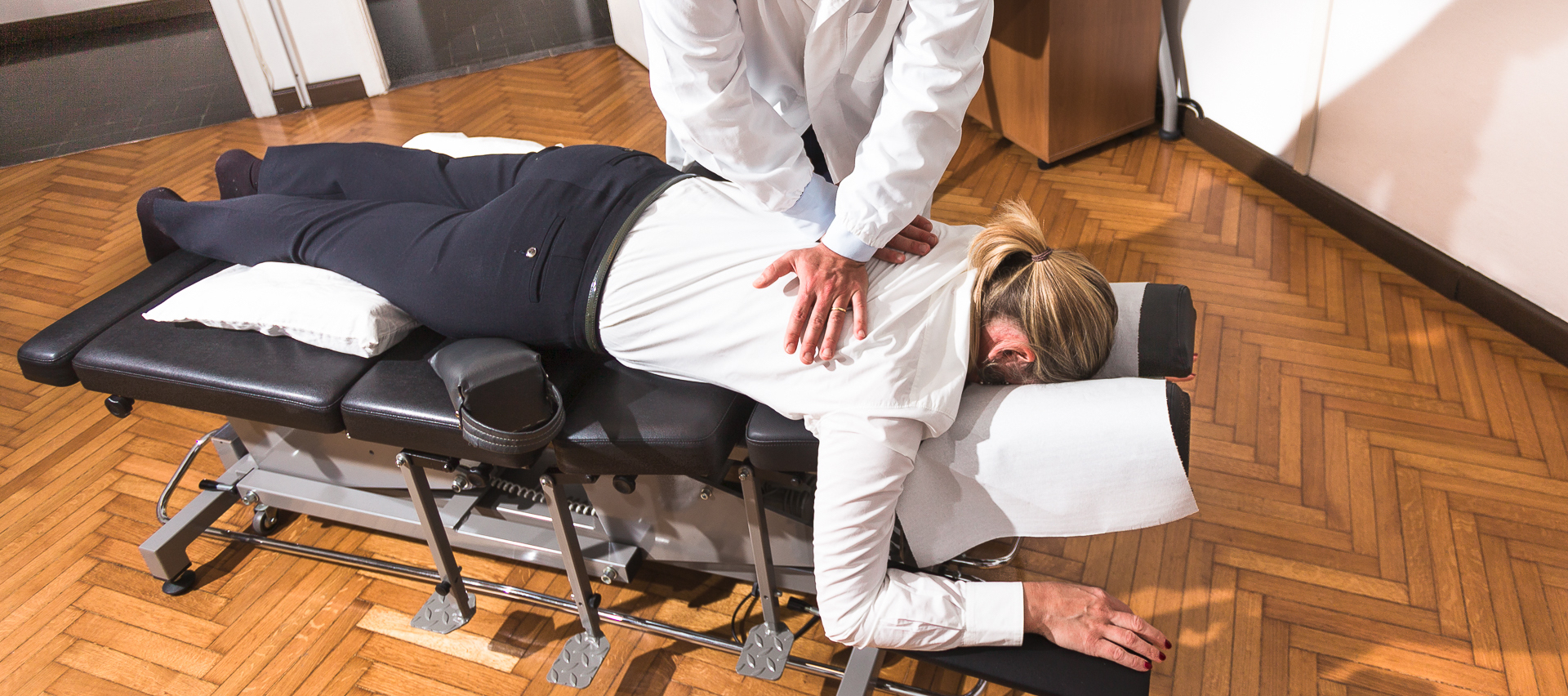
The First Visit We assess the patient’s case in depth. Our orthopedist may prescribe diagnostic tests. The chiropractor then conducts a neurological, postural, and mobility evaluation.
The treatment plan is customized based on medical imaging, lab tests, and physical exams.
How We Treat Herniated Discs: Our Holistic Approach
Each case is unique. Our goal is to restore spinal and neurological function at the root—not just to mask symptoms.
The First Visit We assess the patient’s case in depth. Our orthopedist may prescribe diagnostic tests. The chiropractor then conducts a neurological, postural, and mobility evaluation.
The treatment plan is customized based on medical imaging, lab tests, and physical exams.
Treatment phases:
- Pain Relief Phase – Reduce pain and inflammation
- Rehabilitation Phase – Regain mobility and function
- Maintenance Phase – Prevent recurrence and support long-term health
Session frequency varies by case. Some require daily visits, others weekly. Frequency gradually decreases as stability returns.
In acute cases, we advise avoiding physical exertion after sessions to allow spinal recovery.
Hydration is critical. Many disc patients are dehydrated—we recommend at least 1.5 liters of water per day.
As symptoms improve, we introduce light movement, walking, and our specialized “Back School” exercises.
In the maintenance phase, we encourage monthly checkups to preserve spinal mobility and nervous system function.
How long does it take?
Disc injuries take time. Improvements are often seen within four weeks, but full recovery may take several months.
Early resumption of movement and Back School exercises help accelerate progress.
Do you live outside Milan?
We offer a dedicated program for patients who live far away. You can start with an online consultation to review your case and medical reports.
The online consultation costs €40, which is discounted from your first in-person visit, if booked.
If you’re suffering from back pain or sciatica, contact our clinic today and explore our page dedicated to specific exercises.
Always consult our chiropractors before starting any exercise program for disc-related conditions.
Book your visit
To book an appointment at our Milan office:
Tel: +39 02 89.40.49.90
WhatsApp: +39 393 81.04.359
Email: segreteria@studiomazzinisrl.it
Online consultation
If you live outside Milan, you can book your consultation online.
Bibliography
Kassidy JD, Thiel HW, Kirkaldy-Willis KW. Side posture manipulation for lumbar intervertebral disc herniation. J Manip Physiol Ther 1993;16: 96-103
Nwuga VCB, Relative therapeutic efficacy of vertebral manipulation and conventional treatment in back pain management. Am J Phys Med 1982;6:273278
Bozzao A,Gallucci M, et al. Lumbar disc herniation: MRI imaging assessment of natural history of patients treated without surgery. Neuroradiol 1992;185:13541
Wiesel SW.A study of computer-assisted tomography:the incidence of positive CAT scans in an asymptomatic group of patients. Spine 1984;9:549-51
Chapman-Smith D. La professione Chiropratica 2004.
Vedi libro “La Professione Chiropratica” pagina 118 .4″
Pope MH, Phillips RB, Haugh LD, et al. A prospective randomized three-week trial of spinal manipulation, transcutaneous muscle stimulation, massage and corset in the treatment of subacute low back pain. Spine.
Triano JJ, McGregor M, Hondras MA, et al. Manipulative therapy versus education programs in chronic low back pain. Spine. 1995;20(8):948-955.
Santilli, V, Beghi E, Finucci S (2006) Chiropractic Manipulation in the Treatment of Acute Back Pain and Sciatica with Disc Protrusion: A Randomized Double-blind
Clinical Trial of Active and Simulated Spinal Manipulations, The Spine Journal, in press.
Boos N, Rieder R, Schade V, Spratt KF, Semmer N, Aebi M. 1995 Volvo Award in clinicalsciences. The diagnostic accuracy of magnetic resonance imaging, work perception, and psychosocial factors in identifying symptomatic disc herniations. Spine 1995; 20: 2613-25.